
Eightfold’s Journey: Building a Future Where Talent Finds Its Place


In 2016, two men, Ashutosh Garg and Varun Kacholia, looked at the way businesses did their work and discovered something.
It was unsettling enough for them to actually decide to change things. What could have been so upsetting?
They saw that talent was being treated like inventory, and resumes were being used to judge people.
Basically, they realized that during hiring, real potential was being ignored.
They thought, what if machines could help these businesses look beyond the obvious and towards what someone could become?
This vision gave rise to the idea of Eightfold, a platform built not merely to track skills, but to gauge potential and map promise.
It was designed to help pair people’s latent capabilities with places where they might grow.
Actually, it’s smarter than that.
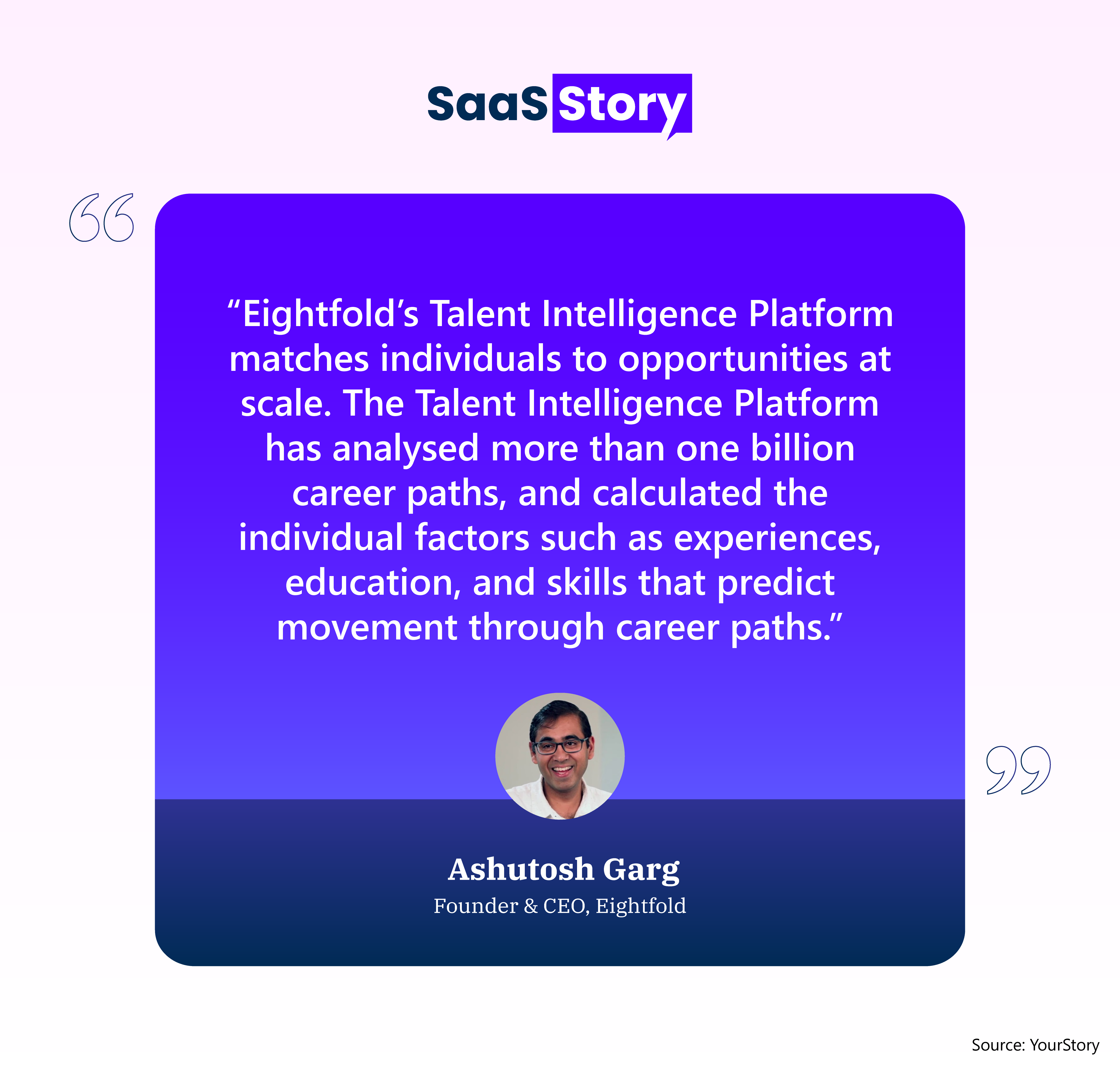
It doesn’t just match what someone has done with what they want to do.
It helps organizations see talent differently and enables individuals to find better paths.
All of this is powered by AI, deep learning, and the belief that change doesn’t wait for perfection; it often comes through alignment of tools, values, and human will.
Ashutosh had spent years in machine learning and search at Google and IBM Research, slowly gaining a deep expertise.
Varun, too, spent time coding at Google and Facebook, leading ranking, recommendations, News Feed.
Both had seen what AI could and couldn’t do, leading to bias, inertia, and missed chances. They wanted to build something to change that.
Today, Eightfold is not just a technological marvel, but a mirror for companies to see what their people could be.
It tells individuals to envision the roles they might take on, all while operating behind dashboards, algorithms, and the unfolding of rewarding careers.
What Is Eightfold?
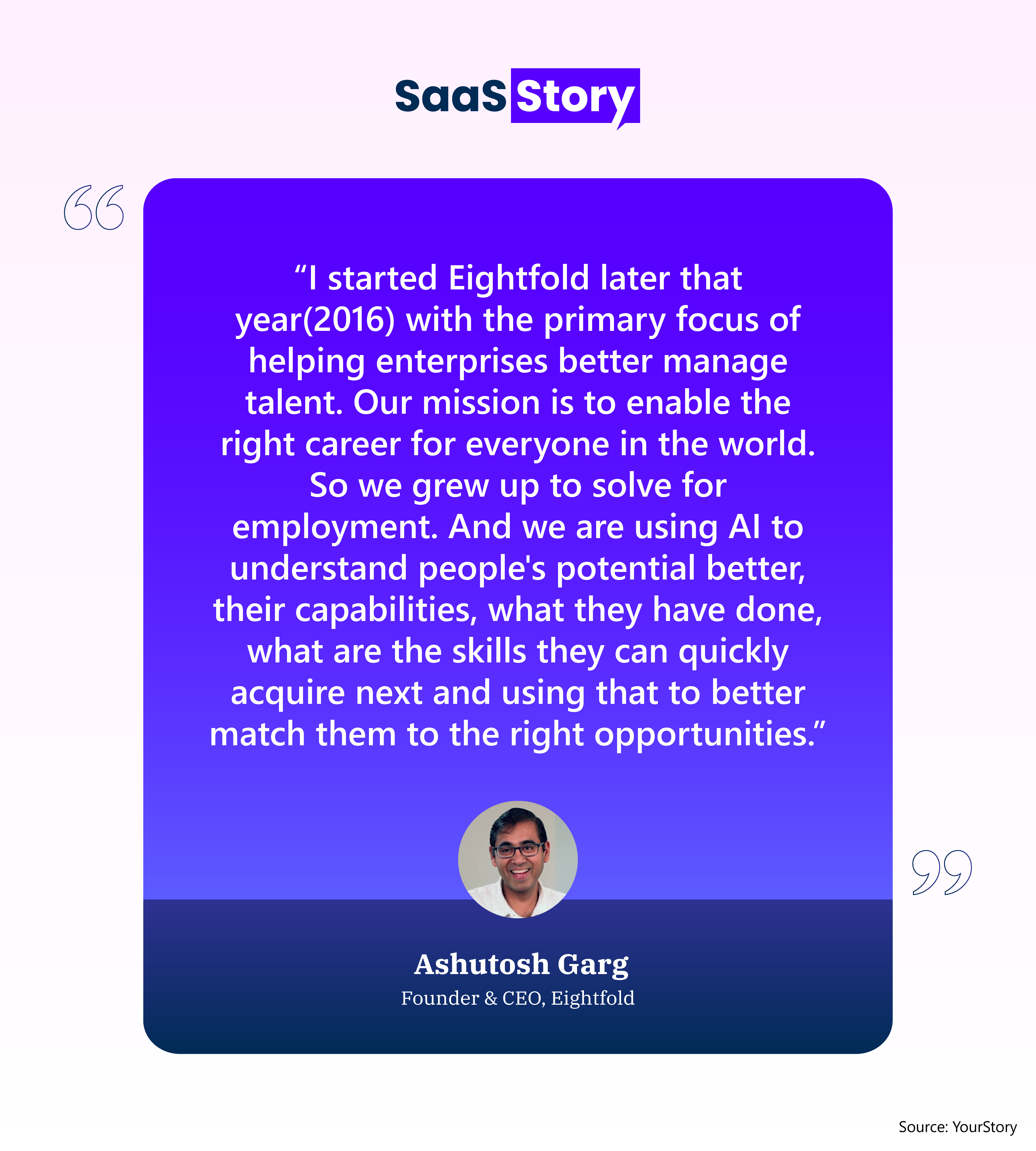
Eightfold calls itself “The only talent platform built for change by pairing the potential of people with agentic AI.”
At its core, the company is trying to solve a simple but stubborn problem: organizations hire and manage people based on what they were, not what they could be.
As a result, skills get overlooked and potential remains hidden. Eightfold’s mission is to change this.
The company serves as a platform that unifies talent acquisition, management, resource planning, and workforce exchange in one system.
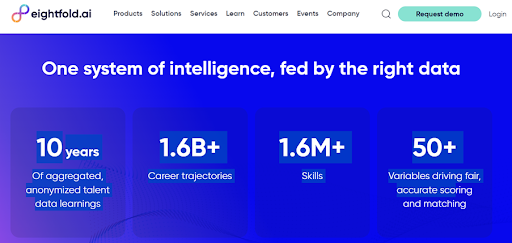
It doesn’t just list jobs and resumes; it maps billions of career paths, millions of skills, and variables that influence growth.
This allows companies to see their people through a lens of possibility rather than limitation. For employees and job seekers, it means guidance on where they can go next, not just where they fit today.
Eightfold’s customers range from global enterprises to US federal agencies. In fact, many enterprise customers have reported successes such as:
- 500% ROI through reduced recruiting agency spend
- 50% reduction in time to hire
- 115% increase in applicants
- 85% reduction in time to discover diversity candidates
- 120% increase in filling roles with existing employees
Each uses the platform to connect roles with skills more fairly and uncover internal talent often hiding in plain sight.
It also gives workers clearer opportunities for advancement. In practice, this can mean a telecom company re-skilling thousands of employees for new digital roles, or a defense agency matching reservists to critical mission needs in real time.
While explaining the platform, Ashutosh said, “Let’s say, for example, an oil company wants to move towards alternative energy.
Then, it can get a visual representation of what skills its workforce has and see where there’s a gap. It can even look at how its skills compare to competitors’ skills.
This is a platform that is very valuable to a company wanting to transform itself, and make sure the talent it has is the talent it needs.”
Eightfold emphasizes the deployment of “agentic AI,” autonomous systems designed not only to analyze but to act.
This technology works alongside recruiters and managers to make talent decisions faster and with less bias. It’s a vision of technology as a collaborator, rather than just a calculator.
As for the name, “Eightfold” is borrowed from the Eightfold Path in Buddhist philosophy: a framework for balance, clarity, and right action.
The choice reflects the company’s belief that building better talent systems is more about fairness, inclusion, and long-term progress.
Know the Founders - Ashutosh Garg and Varun Kacholia
Ashutosh Garg grew up fascinated by problems that live in the shadows.
He studied at IIT-Delhi, earning a BTech, and went on to get a PhD in Computer Engineering from the University of Illinois at Urbana-Champaign.
As a budding entrepreneur looking to solve real problems, he realized that data that wasn’t being used led to potential that went unseen.
His time in academia and research laid deep foundations in terms of writing papers, building AI systems, and inventing through patents.
Before Eightfold, Ashutosh worked at Google and IBM Research, then co-founded BloomReach.
He was always drawn toward systems that could learn and adapt, not just compute.
Varun Kacholia’s trajectory is different in detail but similar in spirit.
He earned his undergraduate degree in Computer Science from IIT (India), then a Master’s from the University of California, Berkeley.
Early in his career, he tackled problems of ranking, search, and recommendations while working at Google and Facebook.
He led teams at YouTube Search & Recommendations, and at News Feed in Facebook.
What drew him to those roles was the possibilities that models presented when they saw beyond clicks and titles, and unearthed patterns in behavior, skills, and people.
The two future leaders met through overlapping work in AI and machine learning circles.
Both saw that traditional hiring and workforce systems use traditional tools like resumes, job titles, and keywords.
They recognized that such processes left talent unseen and limited possibilities.
They believed that machine learning could help peel back those layers to find what people could truly become in the future.
And then, they founded Eightfold on this conviction.
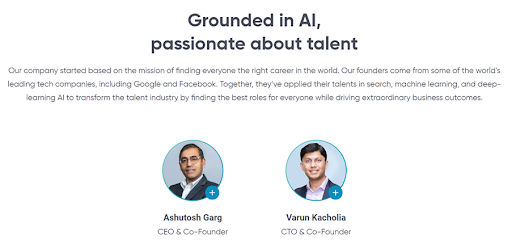
Their shared motivations came from frustration and hope. Frustration at the flawed hiring procedures and the resulting talent wastage.
They did, however, harbor hope that data, combined with AI, could make systems fairer and more flexible.
Together, they built Eightfold to combine their experience in AI and search to build tools that see beyond the apparent.
Challenges Faced and Overcome
Every climb has steep stretches. For Eightfold, many of those stretches came in the form of external doubt, internal scaling pains, and the complex moral weight of AI in hiring.
One big challenge was market credibility and funding pressures.
As an AI company trying to change how talent systems work, Eightfold needed capital as well as confidence from investors, enterprise customers, and HR leaders.
Though the company secured large funding rounds (Series D and then a massive Series E led by SoftBank in 2021, boosting its valuation to $2.1 billion), that influx of capital came with expectations.
They had to maintain the product momentum, hire engineering and data science talent (especially in India), and expand globally. Falling short in any of these areas could shake trust.
Scaling also meant handling bias, fairness, and trust issues.
The promise of AI-powered talent matching raised immediate concerns: could the algorithms replicate existing bias?
Would individuals and companies accept decisions driven (in part) by a machine?
Eightfold has published about “culture fit” reinforcing certain biases, and about how many organizations struggle with internal mobility, succession planning, and bias prevention.
This made the mission more demanding. It wasn’t enough to build something that works; it had to be ethical, transparent, and fair.
There were also operational and cost constraints.
With rapid growth comes larger costs: hiring, data infrastructure, maintaining high model performance, ensuring compliance across geographies, and meeting enterprise security/privacy demands.
During more challenging economic climates, pressure builds to optimize spending, justify valuations, and balance expansion with sustainability.
Though Eightfold raised large sums, managing those resources under scrutiny would have tested leadership.
Further, like many tech companies, they faced organizational growing pains.
As size, markets, and customer expectations increased, complexity mounted:
- product roadmap choices
- user feedback loops
- hiring staff across continents
- integrating new features without breaking trust
Despite these pressures, Eightfold leaned into its mission. They invested in fairness and bias auditing.
The next step was publishing thought leadership about bias and “culture fit,” which acknowledged what could go wrong rather than pretending otherwise.
Moreover, they used funding rounds not just to scale fast, but to build tools, people, and structures that uphold quality.
They also chose to grow in parts of the world with strong AI talent (India, for instance), helping maintain both cost-effectiveness and domain expertise.
When expectations rose, they responded with product development, i.e., better matching, deeper skills inference, and expanding the customer base.
In the end, Eightfold’s ability to face doubts about AI-based hiring, absorb feedback (negative and positive), and manage growth ethically has helped it emerge as a startup that many can look to when thinking about what fairer systems could be like.
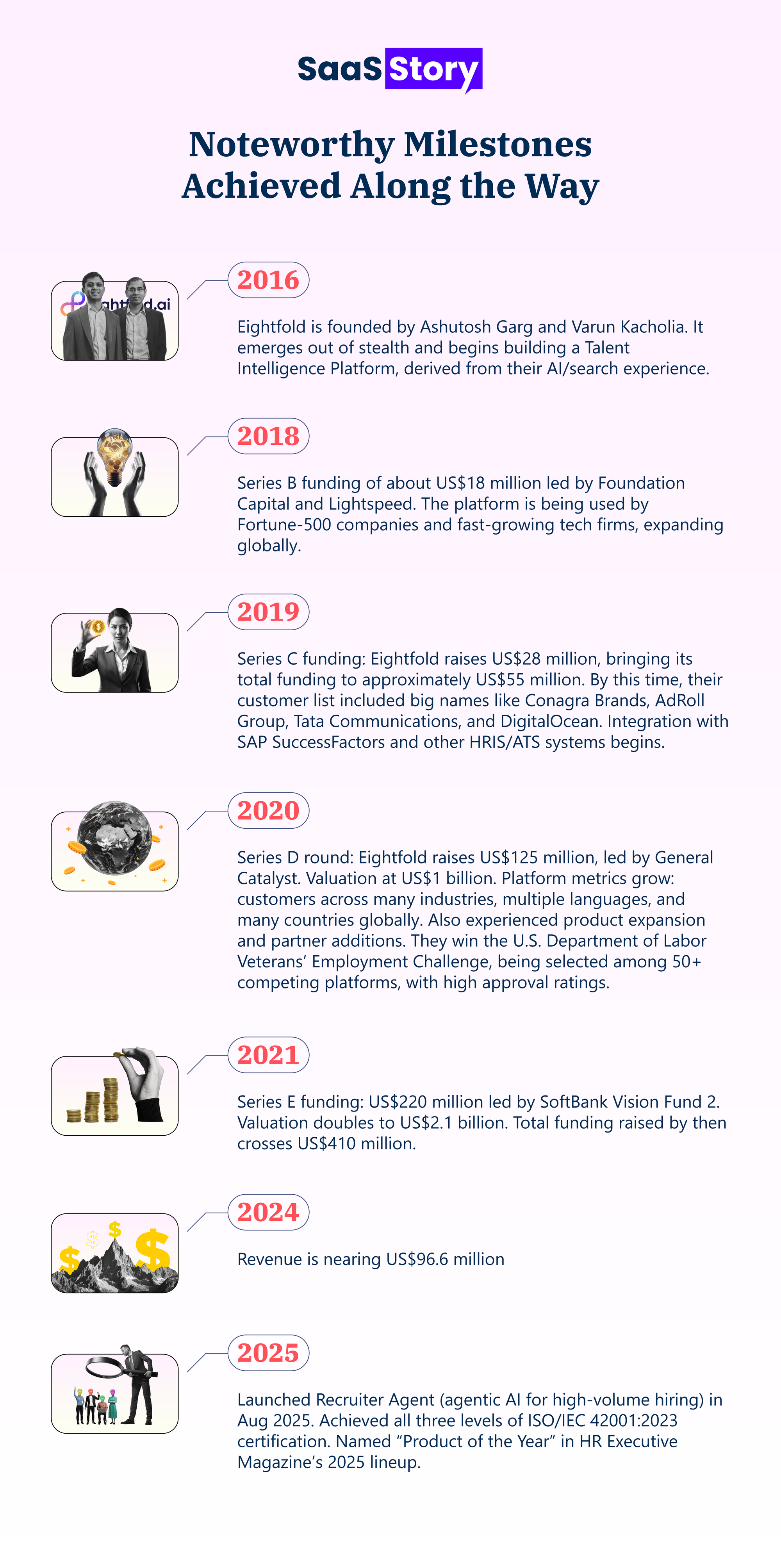
Noteworthy Milestones Achieved Along the Way
As you can see, hard work does pay off. Maybe not instantly, but over months and years, it does. With this in mind, let’s skim through some of the key milestones to Eightfold’s credit today.
Lessons Learnt
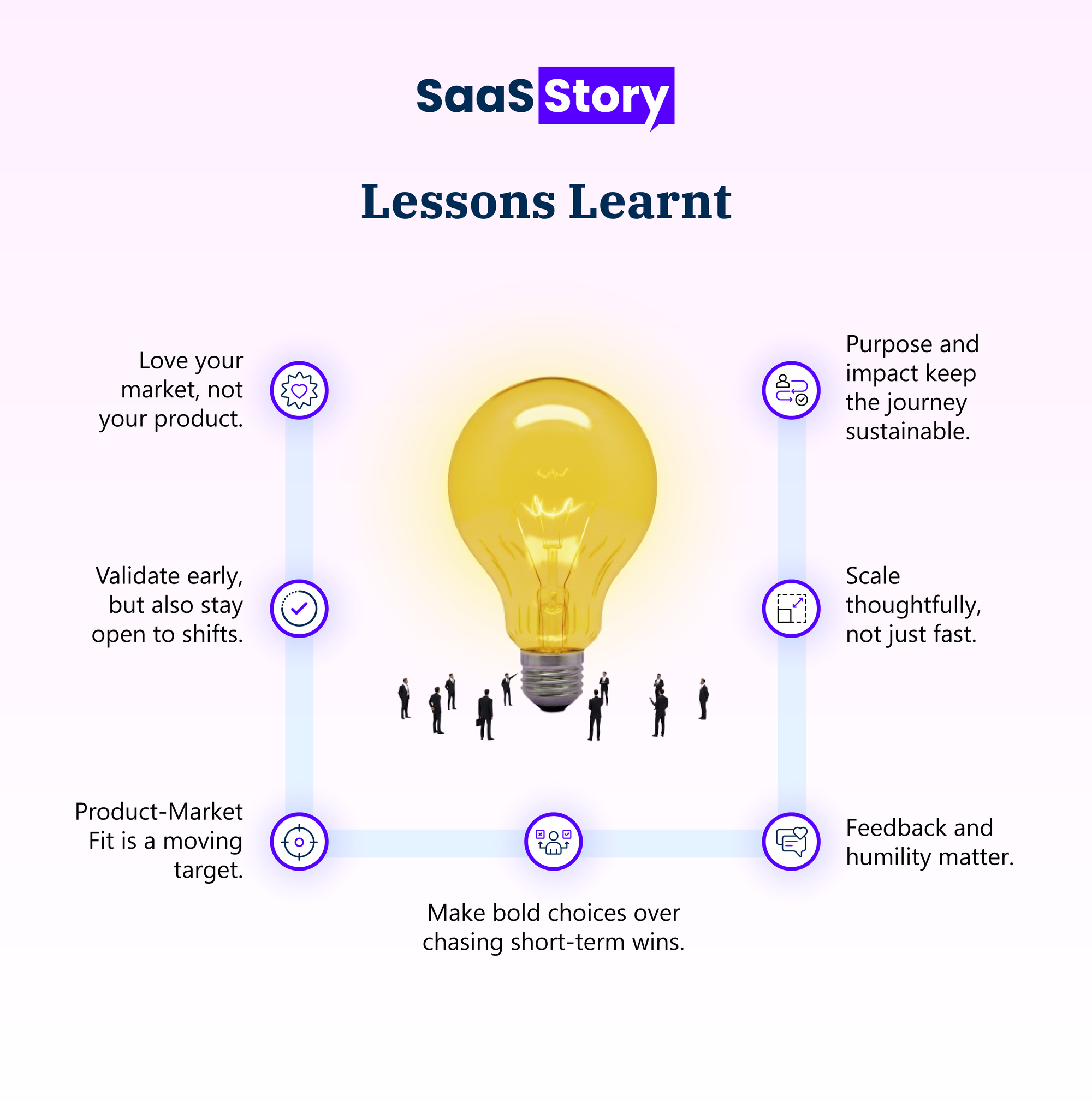
Love your market, not your product.
Ashutosh emphasizes that no matter how beautiful your tech is, if it doesn’t solve the real pain people feel, you’ll miss out on a major opportunity. It’s the market’s needs that should guide iteration, not your attachment to your own idea.
Validate early, but also stay open to shifts.
Early on, Eightfold pitched ideas, talked to many CHROs, and gathered signals. Sometimes those signals led them to pivot or adjust. Ashutosh says being rigid kills more startups than changing course early does.
Product-Market Fit is a moving target.
While the company pushed the hard-to-find PMF (product-market fit), it also acknowledged that even after finding it, the world keeps evolving, requirements keep shifting, and staying still is risky. Accordingly, you must keep tuning in to keep up.
Make bold choices over chasing short-term wins.
Ashutosh talks about choosing big markets over hot short trends, and building for where things could go in 10-20 years, not just what looks juicy now. Being patient and making foundational bets paid off for Eightfold.
Feedback and humility matter.
When you start something new, you’ll encounter rejection and criticism, indicating that you may be off track. Ashutosh says you must listen, be vulnerable, and incorporate what you hear, but not take it personally. This is how a product continuously improves.
Scale thoughtfully, not just fast.
Scaling a SaaS company involves looking beyond the numbers related to hiring, pricing, and other metrics. It’s not just about growing headcount or revenue, but ensuring that the product retains quality, people understand their roles, and customer satisfaction doesn’t fade.
Purpose and impact keep the journey sustainable.
Ashutosh left BloomReach wanting to do something more socially meaningful. He saw employment and helping people align with work as deeply impactful. That clarity of purpose helped him stay motivated during tough times.
Conclusion
Eightfold’s story is still unfolding, but the arc already carries weight. Two tech professionals, who once studied search engines, chose instead to search for human potential and ended up building something bigger than a chunk of code. Today, their platform is a product backed not only by algorithms, but also persistence, humility, and conviction so that outcomes can be fairer.
The many challenges they faced were real, and the rejections were frequent, but lessons hidden in those moments made the company stronger. Today, Eightfold exemplifies that technology, when steered with purpose, can be used for more than just efficiency. It can open doors of opportunity.
Subscribe to our newsletter.
Be the first to know - subscribe today