
From Messaging to Conversations: The Business Story behind Gupshup’s Rise


They say conversations shape the world.
But what if machines could talk like us, humans?
Not just talk, but also listen, understand, answer, and even persuade?
That’s what Gupshup is trying to build.
At first glance, Gupshup seems like any other AI platform rising in a crowded industry. But its story moves differently. It aims not just to assist, but to embed itself in every customer conversation.
The company’s promise? Autonomous AI agents that accelerate leads, close sales, and delight customers with responses that feel human. So basically, it’s not about offering shiny features. It’s got more to do with enabling businesses to converse at scale, with nuance and depth.
From its home base to its global reach, Gupshup now claims 50,000 customers across 130+ countries, powering 120 billion messages each year.
Recognition has followed: it’s been named an “established leader” by Juniper and picked by Gartner in its conversational AI market guide.
That’s not all. This year, it raised USD 60 million in equity + debt to double down on product innovation and global expansion.
However, behind these numbers lies a longer, more complex journey. Gupshup started as a messaging/conversational app, then pivoted and nearly disappeared, but managed to re-emerge.
Its evolution mirrors that of the tech world itself, from SMS platforms to chatbots to the era of AI agents.
Central to our narrative is Beerud Sheth, a co-founder who has built more than one empire (for example, Elance, which is now known as Upwork). In this story, we’ll walk through his journey and learn how a young tech dreamer became a pioneer of conversational AI.
Actually, this post will trace three stories at once: the story of Gupshup, its founders (especially Beerud), and the quiet revolution of how businesses now “talk” to their customers.
What Is Gupshup?

Gupshup runs a conversational platform that helps companies talk to their customers at scale, and in the most natural way possible.
Instead of static forms and ticket queues, it uses AI agents that can lead, reply, route, or escalate conversations across marketing, sales, and support.
But before we talk tech, here’s a tidbit about the company’s name, Gupshup. In Hindi-Urdu, “gup-shup” means casual talk, chatter, and even gossip.
It evokes everyday conversation, in all its light, spontaneous, human-like glory. The founders embraced this image: not stiff “AI systems,” but friendly agents that talk.
Yes, the name indicates intent: business talk shouldn’t feel unnatural. It should feel like a daily gup-shup.
With that being known, let’s find out how Gupshup helps its clients.

- Lead generation and qualification: With “click-to-chat” ads, prospects can start a conversation instead of filling long forms. The AI agent can ask questions, assess interest, and pass on qualified leads to sales.
- Sales and eCommerce enablement: Agents can guide users to products, help with choices, and support checkout decisions, all conversationally.
- Customer support and service: They automate responses to common queries, resolve simple issues, and route tougher ones to humans. This frees up human agents for complex problems.
- Domain-aware conversations: What sets Gupshup apart is that its agents are “industry-trained.” They know banking terms, retail logic, and insurance workflows. That makes their responses more accurate and faster to deploy.
- Omnichannel reach: It doesn’t force you into one medium. Conversations can happen via WhatsApp, SMS, Web chat, Instagram, voice, and even fallback across channels.
- Faster deployment, better control: Clients can pick premade agents, tweak personality, integrate with their systems, manage security, and data. All without putting in months of development into the task.
In practice, brands using Gupshup report sharper engagement, lower costs, and faster response times. For example, Petromin in Saudi Arabia built a car-service assistant on WhatsApp that handles support like a human.
As such, Gupshup’s value lies not in automating for its own sake, but in enabling better human experience at scale, while improving business metrics (leads, sales, support efficiency).
A Brief Introduction of the Founders

Gupshup’s foundation was laid by its founders, Beerud Sheth and Srinivas Anumolu. Their paths were separate yet aligned, converging toward the same mission: making machines talk like people.
Beerud’s roots trace back to India: he studied Computer Science Engineering at IIT Bombay, then moved to the US to study further at Massachusetts Institute of Technology (MIT).
He spent years on Wall Street with firms like Citibank and Merrill Lynch, modeling securities and trading. That’s where he learned about risk, markets, cash flows, and basically all about running a business.
He co-founded Elance (which later became Upwork) with classmates from IIT, including Srinivas Anumolu and Sanjay Noronha, before turning attention to messaging. Srinivas, too, came from technical and entrepreneurial leanings. He believed in platforms, building tools, and scaling value via software.
Around 2004, Beerud and his team launched Gupshup as a messaging service. Over time, the vision evolved and took them beyond messaging and towards conversational AI agents that understand industries like banking, retail, and telecom.
Of course, they didn’t start out with much clarity. There were pivots, near collapses, and moments of doubt.
However, through them all, their vision stayed constant: let computers talk like humans, so businesses don’t feel like machines. For them, Gupshup could be the bridge.

The Long Road: Setbacks, Pivots, and Gupshup’s Survival
Gupshup’s roots trace back to 2004, when Beerud Sheth founded it as an SMS network. From those beginnings to the AI agents platform it is today, the path has seen its share of roadblocks.
The SMS Era and Early Growth
In its early years, “SMS Gupshup” became a group-messaging platform. Users could send a message, and it would propagate to their followers. By 2010, it was throwing off massive volume. In fact, some said it outranked Facebook or Twitter in India in terms of message spread.
But there was a problem: the platform was free. Gupshup was paying telecom operators for every SMS sent. Beerud believed that with scale, SMS costs would fall and monetization would catch up. But costs didn’t fall as expected. Meanwhile, a proposed monetization route, attaching ads to SMS footers, was blocked by regulation.
By 2011, Gupshup was bleeding cash. It was becoming clear that the old model couldn’t last. So, they pivoted from free community messaging toward enterprise messaging. Gupshup began enabling businesses to send transactional messages (e.g., OTPs, confirmations), support messages, marketing communications, and more.
Going Further Down the Rabbit Hole
While the pivot did allow them some breathing space, it didn’t instantly succeed. By 2013, Gupshup again faced cash shortages. Revenues were lagging behind expenses. Cutting costs risked crippling growth, but unchecked spending was unsustainable. The company was close to collapse again. Beerud describes these moments as humbling.
Through this pressure, they learned what real leadership meant. Beerud knew he had to stop micromanaging. He began building processes, trusting teams, and accepting that not every decision would be perfect. The shift worked.
Coming Out on the Other Side in the AI Era
Once stable, Gupshup continued evolving. In 2015, it launched a serverless multi-channel bot platform. Across the mid-2010s, it added APIs for Telegram, Slack, Facebook Messenger, and more.
In 2021, Gupshup raised USD 100 million in a Series F round led by Tiger Global, valuing it at $1.4 billion. This made Gupshup a unicorn. Later that year, it raised another $240 million.
Strategic acquisitions followed: acquiring Dotgo (for RCS messaging), Knowlarity (voice AI), and Active.ai (banking conversational AI) to build a full stack.
And in 2025, it secured $60 million via equity and debt to push global expansion and deepen its AI capabilities.
Accolades and Milestones
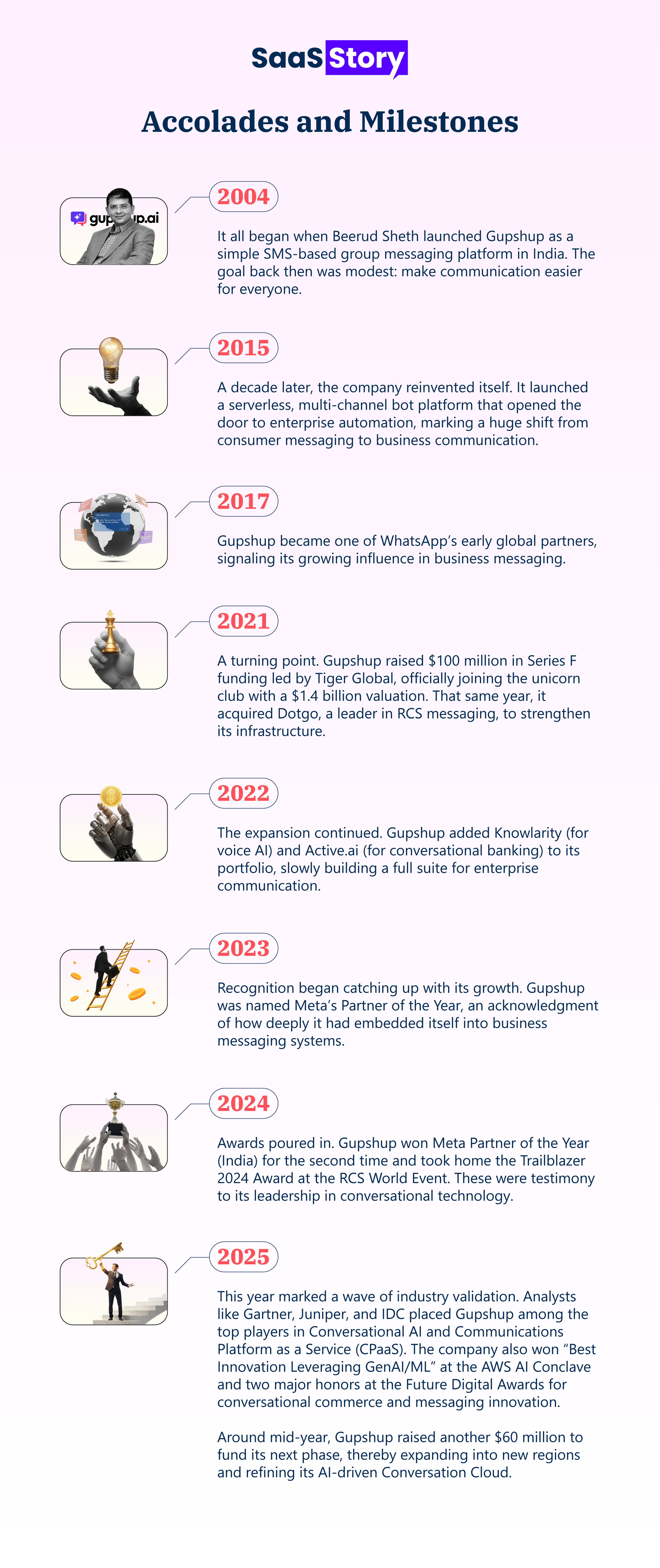
As you can see, every line on this timeline isn’t just a win, but a marker of Gupshup’s survival. From facing a near-collapse to gaining global recognition, Gupshup eventually did exactly what it set out to do: change what conversation means in business.
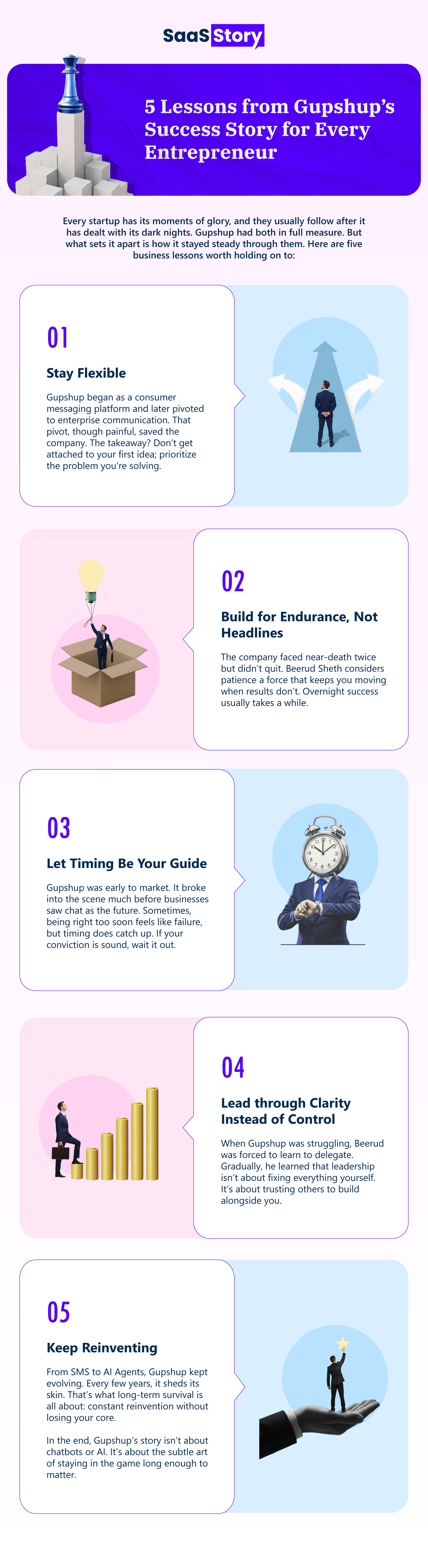
5 Lessons from Gupshup’s Success Story for Every Entrepreneur
“So, if I had to sum it up, I started out as a builder, became a problem solver, and now, my job is to set the direction, bring in the right people, and make sure we’re always thinking long-term. To me, leadership isn’t about doing everything, but making sure the right things get done, with or without you in the room.”
Beerud Sheth
Wrapping Up
Gupshup’s journey isn’t just another startup success story. It’s proof that resilience, clarity, grit, and timing matter more than buzzwords or luck. From near bankruptcy to global recognition, the company has built more than an AI platform. It has built trust in digital conversations.
Beerud Sheth’s quiet persistence turned hindrances into learnings, and learnings into legacy. As AI reshapes how people and businesses talk, Gupshup stands as a reminder that the real goal isn’t to automate speech, but to bring meaning back to every conversation.
Subscribe to our newsletter.
Be the first to know - subscribe today