
Turning Complexity into Clarity: The Hasura Way



Picture this: you’ve just moved to Chennai. You’re craving something that tastes like home: real food, cooked with care. But every street corner you encounter seems to be serving up pizzas and fast food. How are you going to get your fill of home-cooked goodness in this scenario?
This was Rajoshi Ghosh in 2016. Today, however, her longing for wholesome food has managed to nurture millions of developers around the world. We’re not talking about meals, but a new way to build APIs.
Back in 2016, Rajoshi was hunting for a good meal and a better business idea. Little did she know it was about to hit her. She realized that the city she was in had no shortage of food, but it lacked authenticity. So, she decided to fix it.
Around the same time, Tanmai Gopal, a computer science graduate who had just turned down offers from big-name corporates and academic labs, was looking for something meaningful to build. When the two met, their shared obsession with quality (both in food and code) sparked something neither of them had imagined. They decided to build a food delivery platform.
Initially, Tanmai thought they’d build an app for their venture and it’d be easy. But the more they built, the clearer it became: creating reliable APIs was painfully slow and complex. This frustration became their new problem to solve. And thus, Hasura was born.
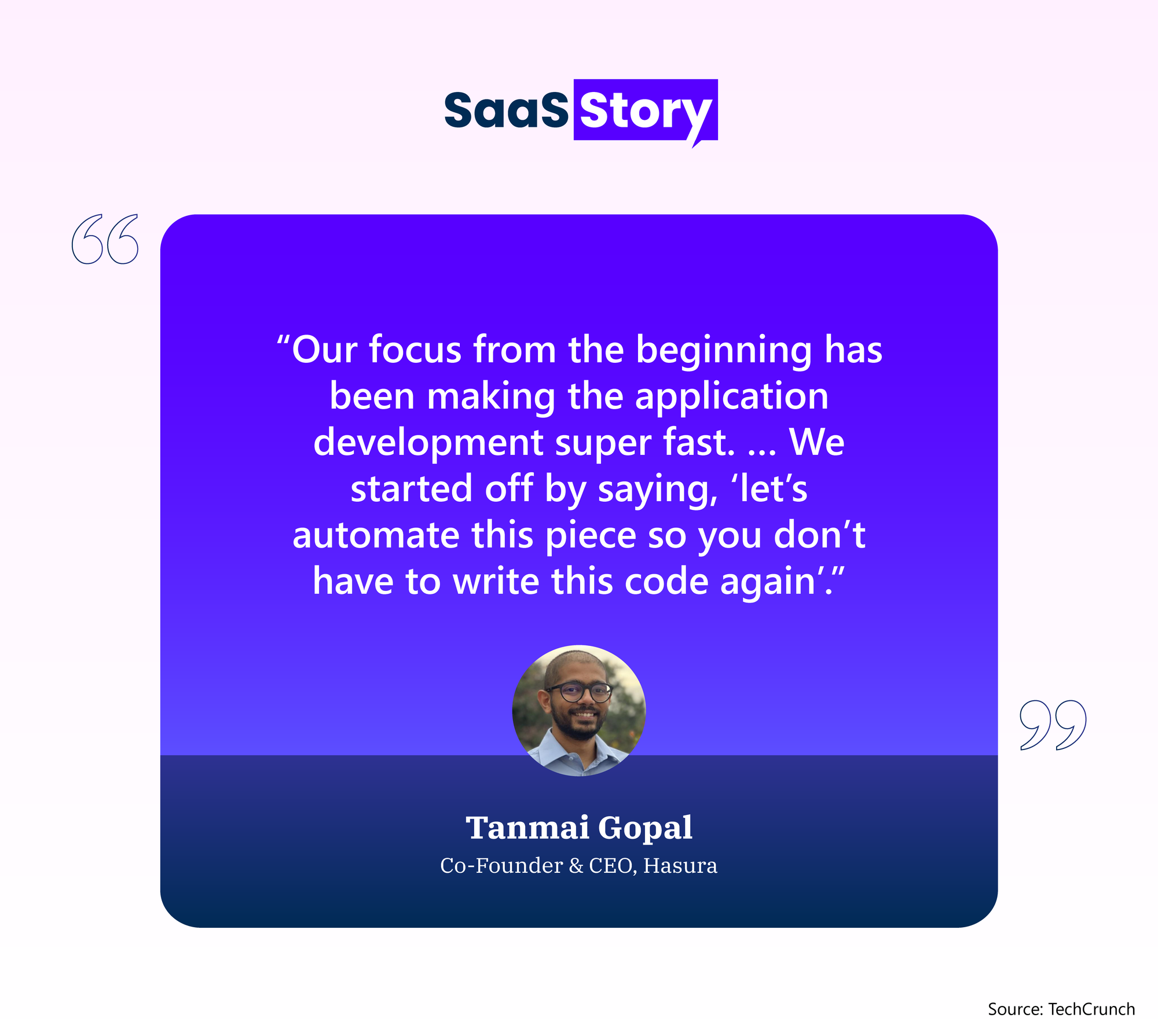
Founded in 2017, Hasura now powers fast, secure, and scalable data access for companies across the world. Its real-time GraphQL engine has crossed 500 million downloads and is trusted by names like Airbus, Atlassian, Swiggy, and Netlify.
It is backed by investors such as Lightspeed Venture Partners, Vertex Ventures, and Greenoaks Capital. Over the years, Hasura has raised over $136.5 million in funding and grown into a global developer movement.
The company is headquartered in San Francisco, with its engineering heart still in Bengaluru. Today, Hasura stands as proof that even the simplest human need can lead to something extraordinary when met with imagination (and code).
What Hasura Is and Why It Matters
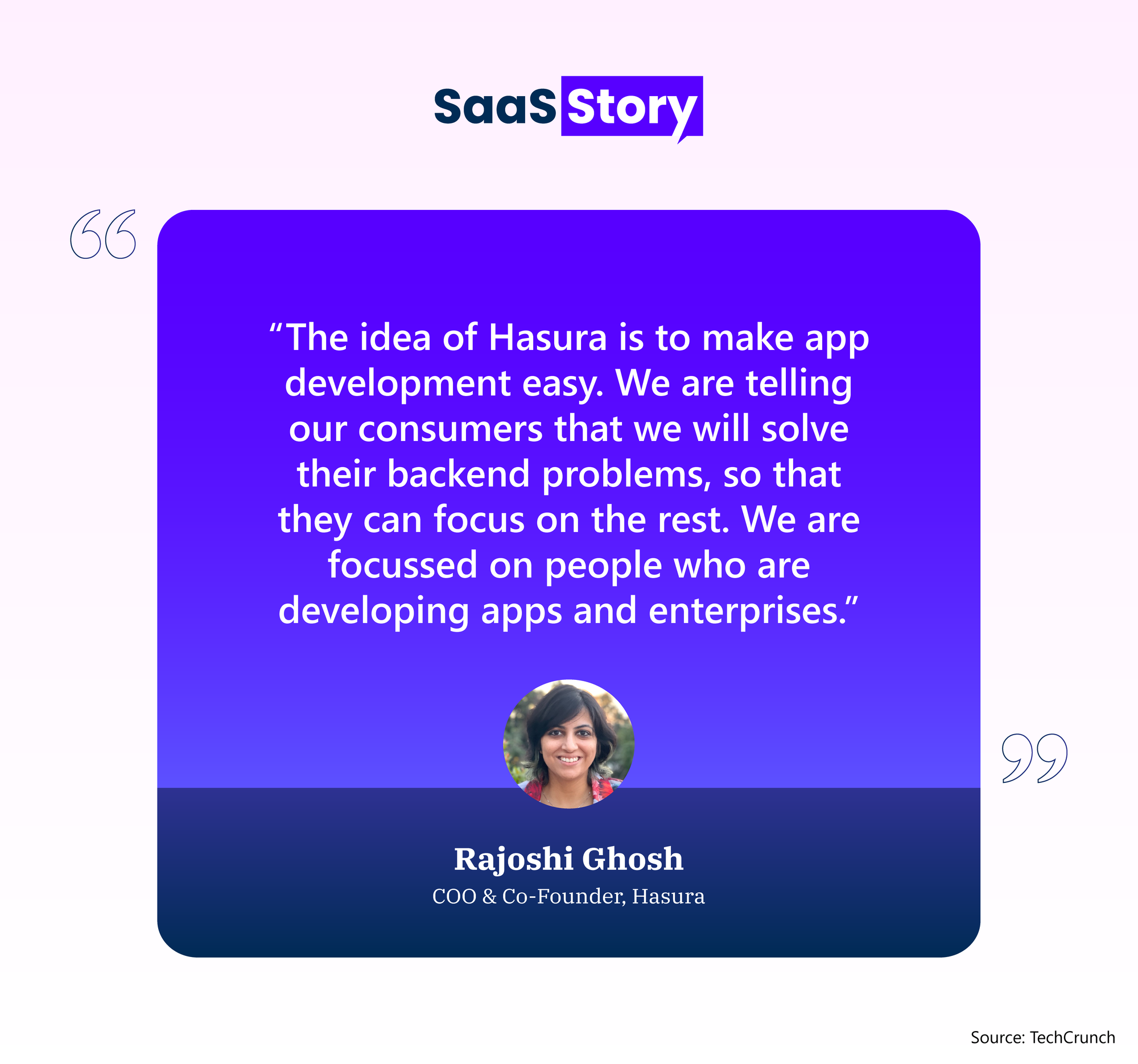
Hasura is a platform that creates data-access APIs fast and securely. It connects directly to your databases, then gives you GraphQL (and now REST) endpoints without building everything from scratch.
Here’s how it works in simple terms: you plug Hasura into your database (for example, PostgreSQL). It tracks tables, views, and relationships. Then it auto-generates queries, mutations, and even subscriptions so your front-end, mobile, or AI app can fetch, update, or listen to data in real time.
So why does this matter to companies and developers?
- They skip months of backend plumbing and focus on building features instead of reinventing access layers.
- They get performance and efficiency because Hasura compiles queries into efficient SQL under the hood.
- They gain strong access control and security: permissions, roles, and field-level security are built in, so data access isn’t an afterthought.
- They can scale: Hasura supports real-time data, event triggers (for example, database insert/update triggers), and a metadata-driven engine that reduces operational overhead.
In practice, this matters for large organisations. For example, teams choose Hasura when they need to speed up their AI or digital initiatives. Here, data must be accurate, fast, and secure. Hasura presents itself exactly this way. It “delivers accurate, fast, and secure data access for AI and digital experiences.”
For entrepreneurs, using Hasura means spending less time setting up backend APIs and more time delivering value (analytics, AI features, real-time experience). It helps align technology with business goals instead of becoming a bottleneck.
“Hasura:” What’s in a Name?
Yes, there’s a story behind the name. The co-founders wanted a name that felt sharp but carried meaning. They considered “Asura” (a Sanskrit word for demon) because in computer science, you have “daemons” (background processes), and they liked the idea of an engine that quietly runs behind the scenes.
Then they added the “H” for Haskell, the language in which much of the core was originally written. So, “Hasura” blends “Haskell” + “Asura”.
Sure, it’s a quirky name. But it hints at the ambition behind the platform: to run quietly and powerfully while handling the heavy data-access work so developers don’t have to.
The Founders and Their Vision

Tanmai Gopal and Rajoshi Ghosh founded Hasura because they knew firsthand how painful data access is in real projects. Tanmai, an IIT Madras alumnus with deep technical chops, reached a point where building apps was too bogged down by backend plumbing.
Rajoshi crossed from research and teaching contexts into startup land, bringing a different vantage point: she cared about impact and building tools that work beyond a lab. They started by running a consulting and product-services company, an experience that taught them what works and what doesn’t in building software at scale.
In 2017, they decided to focus full-time on the tool side and created Hasura to give developers instant access to data without rewriting the wheel. Their vision remains: enable teams to build digital and AI experiences rapidly by removing data bottlenecks. They believe that enabling accurate, fast, and secure data access isn’t a nice-to-have; it’s a precondition for competitive software today.
And they’re not done yet; they’re still iterating. Their journey shows that tools built for developers can scale into enterprise platforms.
How A New Journey Began

From the seed of an idea to building what many now call a Unicorn, the path for Hasura wasn’t smooth. Tanmai and Rajoshi hit roadblocks early and often.
In 2013, Tanmai left conventional career options behind to start something with impact. Rajoshi pivoted, too. After research and teaching abroad, she realised startups were her calling.
Their first venture soon showed the cracks. They had technical strength, but the business model drained time and money. “There were dark days,” when they couldn’t make payroll for two months.
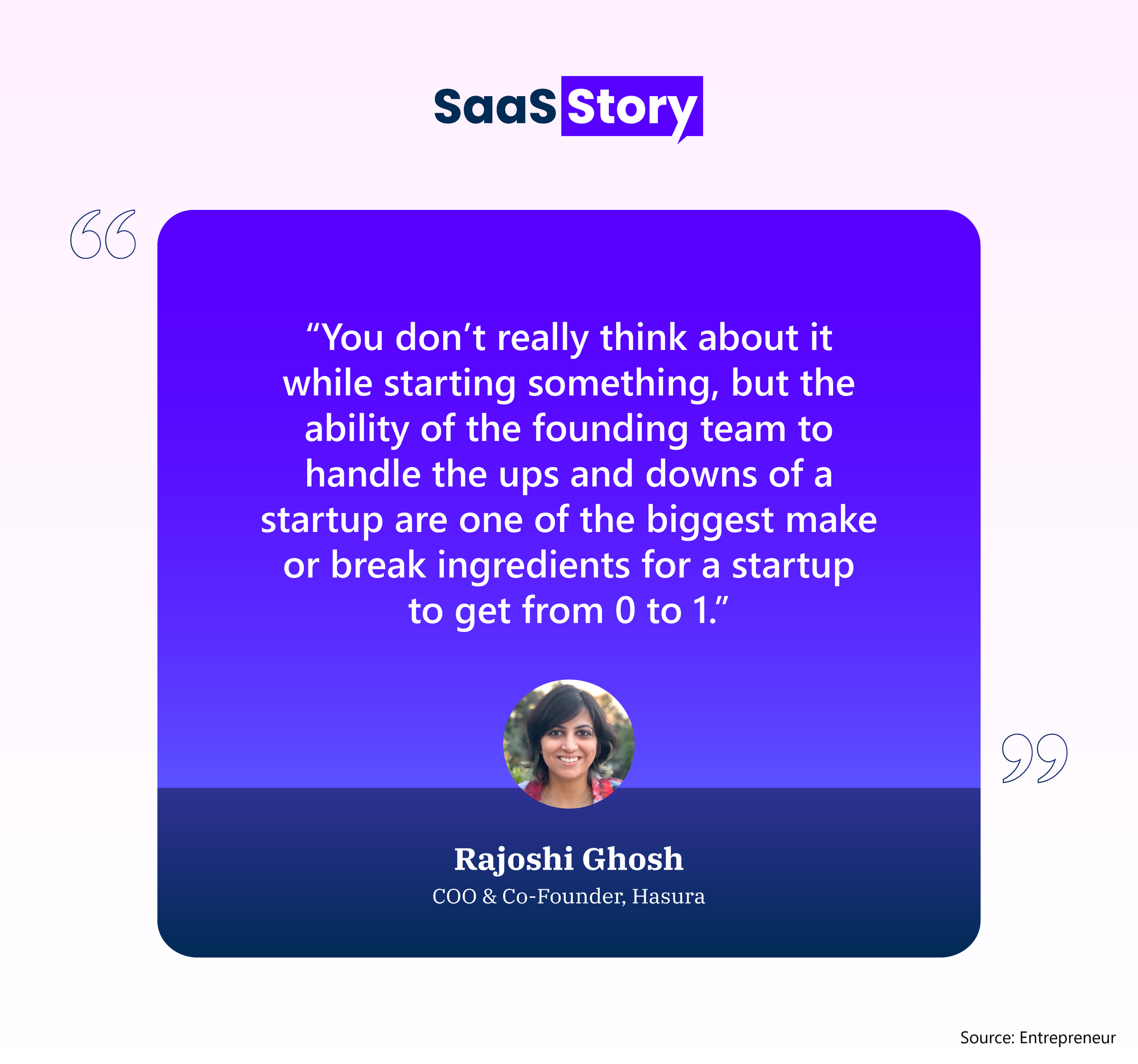
The shift came when they decided to stop doing pure consulting and commit full-time to Hasura. This meant raising capital, convincing investors, finding product-market fit, and turning an open-source tool into a business. Many VCs struggled to see the model: open source plus enterprise is tricky.
Technical challenges piled up as well. They scrapped early versions of what they were building. The final piece that became the GraphQL engine, metadata, and real-time subscriptions evolved through iterations. “The first version of whatever they were building got scrapped out,” said Sameer Brij Verma, managing director at Nexus Venture Partners and VC.
And then there was the open-source paradox: build community, give away a lot of your value, yet create a paid model that makes sense. Hasura’s strength (open source) became its biggest commercial test.
Yet, they kept pushing by staying capital-efficient, focused on developer experience, and kept listening. This helped them know when to pivot and when to stand their ground.

Today, Hasura’s impact shows the payoff. Companies turn to it when data access slows them down, when performance and security can’t be compromised, and when they need to move fast. And that’s the point: the path to success isn’t linear. For Hasura and its founders, it was messy, real, and necessary.
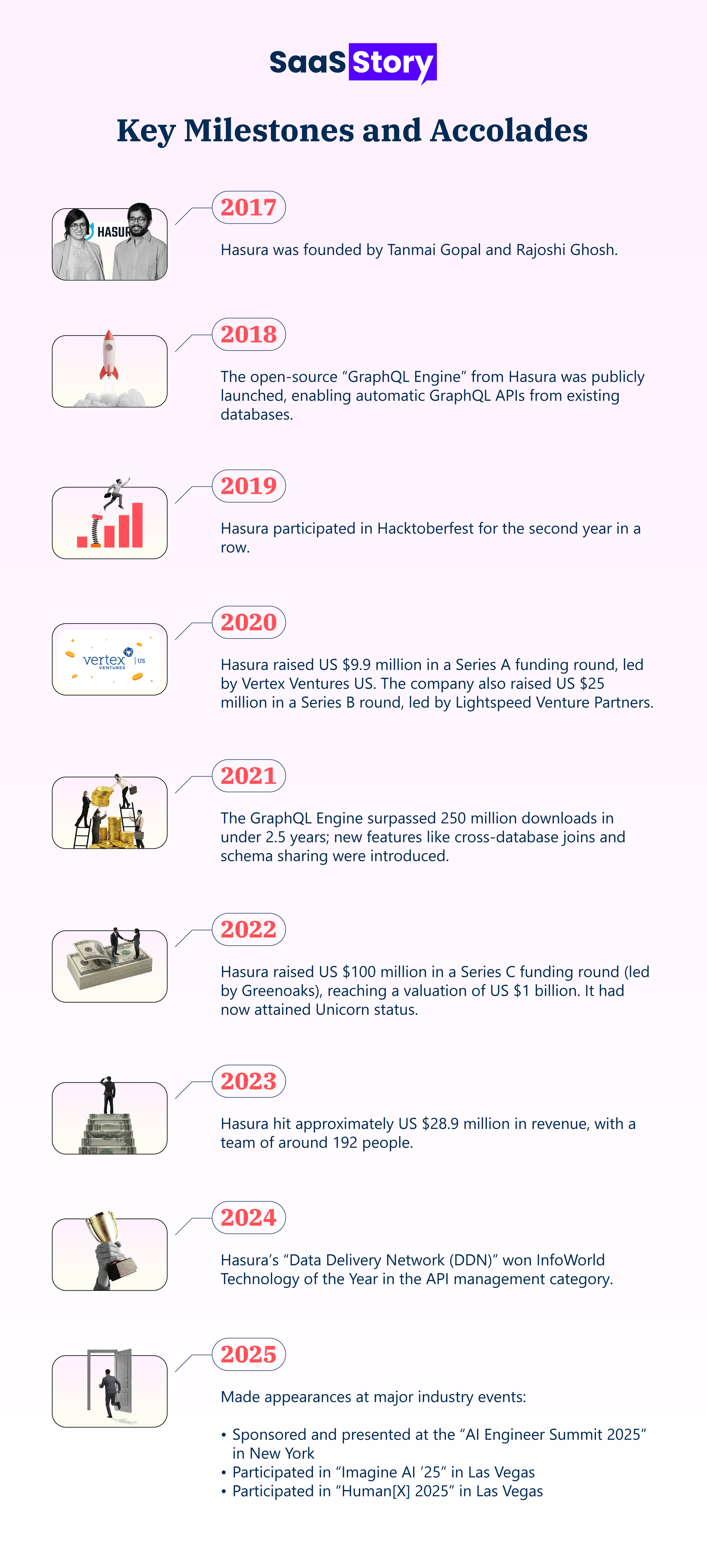
Key Milestones and Accolades
Let’s trace Hasura’s journey from the time it was founded to the present day.
5 Actionable Takeaways from Hasura’s Success Story
As you can see, Hasura’s story is anything but ordinary, with many business lessons that budding entrepreneurs would find helpful. Here are five of the main ones.
1. Focus on Real Problems
Hasura wasn’t launched because GraphQL was trendy. The founders identified a recurring pain: developers spending too much time manually connecting front‑end apps with databases. Their goal was to make it fast and easy for even those with zero GraphQL expertise to compose a GraphQL API from existing APIs and databases.
By targeting that bottleneck, they built something people needed, not just something people heard about. The lesson here is to find the friction your users feel first, then work on the feature they might like.
2. Involve Users Early and Often
Hasura’s early open‑source release (the GraphQL Engine in 2018) allowed developers to tinker, test, break, and suggest. The company then added features like MySQL and SQL Server support specifically because those users asked for it.
When your product evolves with real user feedback, the fit gets stronger and adoption becomes more organic. The message for entrepreneurs is: open your ears, invite criticism, let your users help build the roadmap.
3. Think Global
Though Hasura’s team was relatively small and India‑based, they built with a worldwide developer audience in mind. They supported major databases, broad use cases, and enterprise requirements early. This helped them scale beyond local markets, gain enterprise traction, facilitate more downloads (400+ million by 2022), and create high visibility.
So, lesson no. 3 is: don’t assume your product only needs to serve nearby users. If it works everywhere, aim everywhere.
4. Adapt But Retain Your Core Mission
Hasura’s product and business model did shift. Early consulting experiments, open‑source plus enterprise model, and multiple database support (beyond just PostgreSQL) were definitely pivots. Yet the core promise stayed: fast, accurate, secure data access.
For instance, their Series B funding ($25 m in 2020) was paired with major new database support. This shows entrepreneurs must change tactics when needed, but keep the “why-we-exist” narrative steady.
5. Combine Long‑term Vision with Disciplined Execution
Hasura’s milestone of raising $100 m in Series C in 2022 at a $1 b valuation didn’t happen overnight. It followed years of open‑source growth, product evolution, community building, and enterprise wins. Every sprint mattered.
The lesson: having big goals helps, and working on the daily tasks delivers them. Don’t just talk big, walk the talk and do what’s necessary.
Wrapping Up
By now, you can probably tell that Hasura’s story isn’t loud. But it is steady; the kind that reminds you that success can grow quietly, as long as you keep doing the work. What started as two people trying to make developers’ lives easier has become a name trusted by some of the biggest companies in the world.
Rajoshi and Tanmai didn’t build Hasura on luck, but on patience, curiosity, and a belief that technology should help people move faster, not get stuck in complexity. And somehow, along the way, they built a team that shares that same belief.
Ultimately, Hasura doesn’t just build software; it builds confidence. It gives people control over something that usually feels out of reach. And that’s how quiet revolutions begin.
Subscribe to our newsletter.
Be the first to know - subscribe today